.svg)
.svg)
.svg)
.svg)

.svg)




L'éclat stratégique de l'argent : guide pratique pour l'approvisionnement et la gestion des risques

8 décembre 2025
par l'équipe Ingenius
- La hausse de l'argent en 2025 reste étroitement liée à la solidité de l'or, le métal se négociant dans une fourchette de 27 à 30 dollars vers la fin de l'année alors que les anticipations de taux et les tensions géopolitiques maintiennent les valeurs refuges à un niveau élevé.
- L'argent a vu ses flux entrants dans les ETF ralentir mi-2025, alors même que l'or continuait d'attirer l'essentiel de la demande des banques centrales, ce qui souligne un environnement d'investissement plus prudent mais toujours favorable.
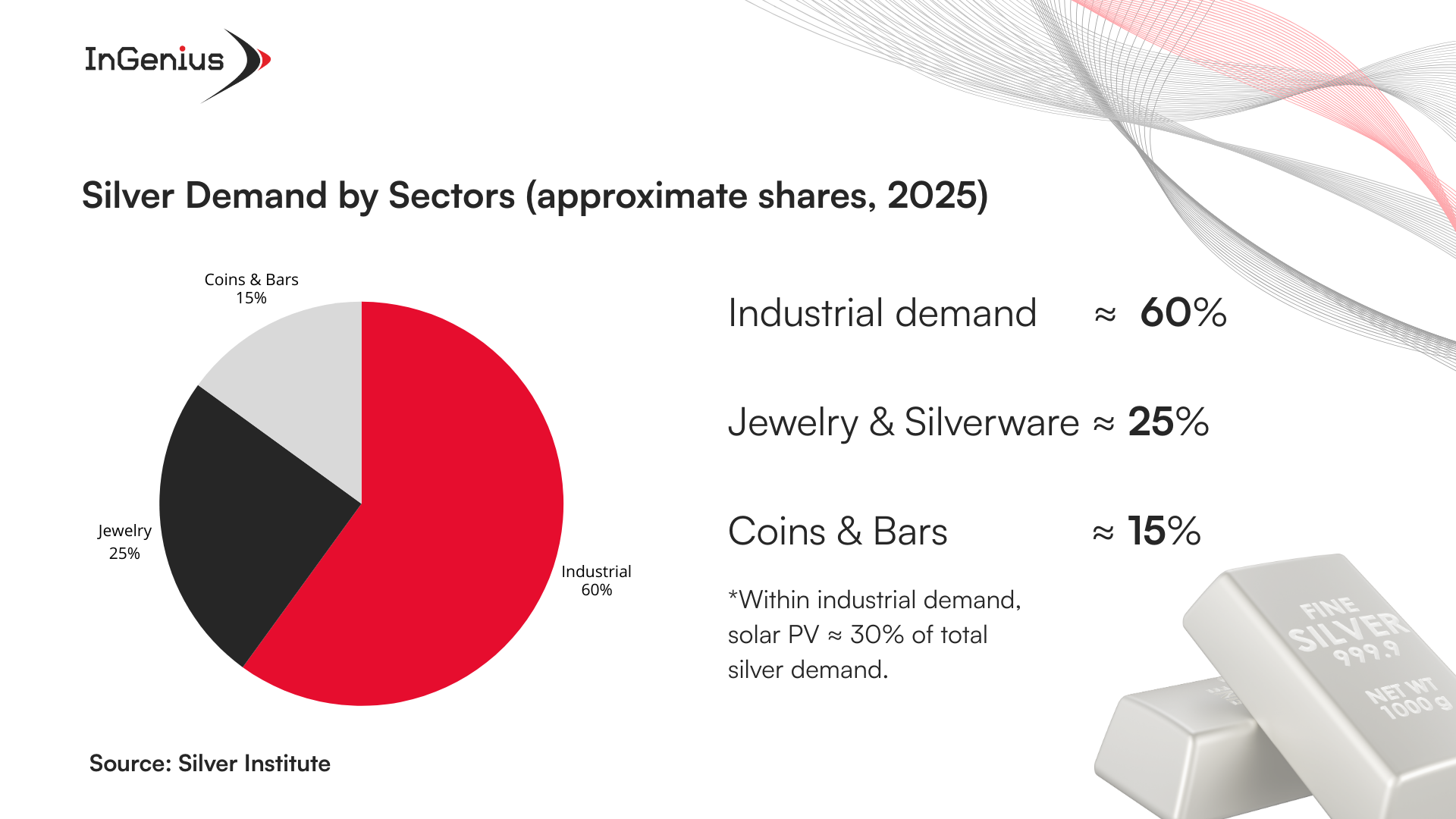
- La demande industrielle demeure le pilier de l'argent, le secteur photovoltaïque consommant à lui seul plus de 180 millions d'onces (soit environ 30 % de la demande en 2025).
- L'argent reste en situation de pénurie structurelle, avec un déficit d'environ 140 millions d'onces prévu pour 2025, marquant la cinquième année consécutive de sous-offre.
- Marchés restent volatils à l'approche du quatrième trimestre 2025, sous l'influence de l'incertitude liée aux baisses de taux de la Fed, des débats sur les droits de douane, des fluctuations du dollar américain et des risques liés aux élections américaines.
La hausse de l'argent portée par la vigueur de l'or
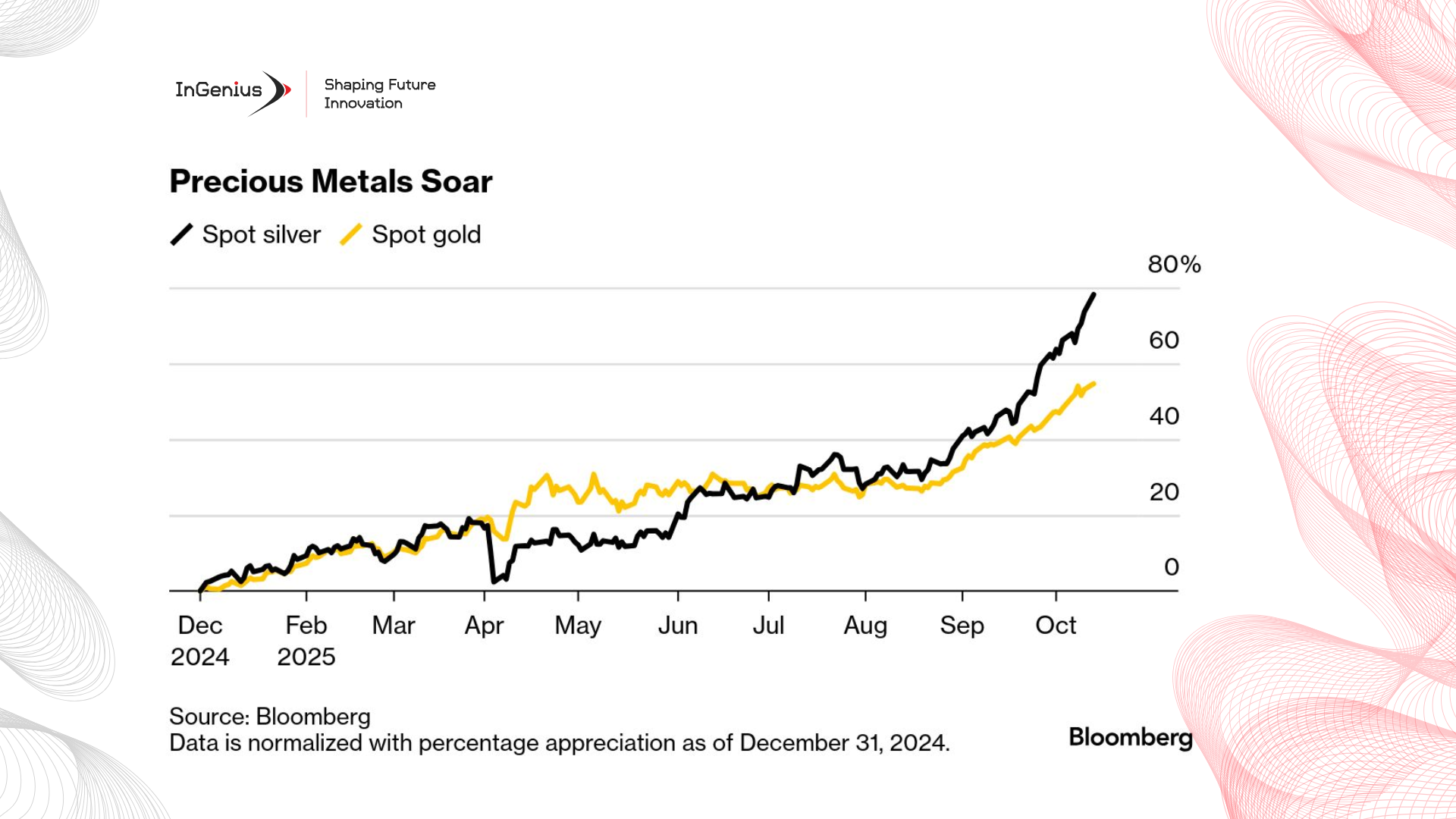
La performance de l'argent en 2025 a étroitement suivi la résilience de l'or, ce dernier s'étant maintenu au-dessus de 2 300 $/oz pendant une grande partie de l'année (Rapport du troisième trimestre 2025 du World Gold Council). Compte tenu de leur corrélation historique de 0,8 à 0,9 (Données de corrélation de la LBMA), l'argent s'est stabilisé autour de 27 à 30 $ vers la fin de l'année 2025.
Cette dynamique n'a pas été linéaire. L'argent a connu de fortes fluctuations au milieu de l'année, les marchés réagissant aux signaux alternés de la politique monétaire de la Réserve fédérale, aux indicateurs économiques faibles et aux tensions géopolitiques. Chaque repli a trouvé un soutien, reflétant une demande persistante de valeur refuge.
Dans l'ensemble, ces dynamiques renforcent la double identité de l'argent, à la fois couverture monétaire et matière première industrielle stratégique.
Les banques centrales et les ETF stimulent, mais compliquent également, la dynamique de l'argent
Le milieu de l'année 2025 a été marqué par un ralentissement des flux entrants dans les ETF argent (Metals Focus, octobre 2025), alors même que l'or a continué de dominer les
accumulations (World Gold Council, Enquête 2025 sur l'or des banques centrales).
Des achats de premier plan, comme l'exposition de 40 millions de dollars liée aux matières premières de la
Banque centrale d'Arabie saoudite (couverture de Reuters de juin 2025), ont soutenu le sentiment du marché sans pour autant marquer un achat massif d'argent par les banques centrales.
L'or demeure le principal métal de réserve.
Pour les responsables des achats :
- Les flux des ETF façonnent la liquidité et la dynamique des prix.
- Les politiques des banques centrales privilégiant l'or renforcent l'ensemble du secteur des métaux précieux.
- La volatilité de l'argent liée aux investissements reste élevée,
ce qui rend le suivi des tendances des ETF essentiel pour la planification des risques.
La demande industrielle maintient l'argent sous les projecteurs
L'importance stratégique de l'argent en 2025 repose sur son usage industriel. Plus de 50 % de la demande mondiale provient désormais de l'industrie, tirée par le secteur photovoltaïque (PV). Selon le Silver Institute 2025 Interim Review, le photovoltaïque consomme à lui seul plus de 180 millions d'onces par an (≈ 30 % de la demande totale).
Les moteurs de croissance actuels incluent :
- L'électronique de puissance et les systèmes de batteries pour véhicules électriques (IEA Global EV Outlook 2025)
- Les semi-conducteurs avancés et l'instrumentation médicale
- La distribution d'énergie et les technologies de capteurs liées aux normes d'efficacité énergétique
Bien que les ventes de bijoux et d'argenterie aient fléchi en raison de la hausse des prix, l'essor des technologies vertes a maintenu une consommation globale robuste. En matière d'approvisionnement, l'argent n'est plus une simple valeur refuge passive, mais un intrant industriel essentiel aux possibilités de substitution limitées, ce qui souligne la nécessité de partenariats d'approvisionnement à long terme.
Contraintes d'offre et déficits de marché
L'offre minière mondiale n'a progressé que d'environ 2 % en 2025 (GFMS Metals Outlook Nov 2025), continuant de rester en deçà de la demande. Le Silver Institute prévoit un déficit d'environ 140 millions d'onces, marquant la cinquième année consécutive de sous-offre.
Le recyclage a légèrement augmenté mais reste insuffisant pour combler les déficits. Une amélioration modérée pourrait survenir fin 2026 avec la mise en service de nouveaux projets au Mexique et au Pérou (Mining Journal Oct 2025), mais une tension globale persistera.
Pour les chaînes d'approvisionnement :
- Les pénuries structurelles et la volatilité des prix se prolongeront jusqu'en 2026.
- Dans ce marché, les contrats stratégiques et les stratégies de couverture sont plus performants que les achats au comptant.
Considérations stratégiques face à l'incertitude du marché
Les responsables des achats évoluent désormais dans une matrice macroéconomique volatile, les spéculations sur les baisses de taux de la Fed, les fluctuations du dollar, les débats sur la politique commerciale et l'incertitude liée aux élections américaines jusqu'au quatrième trimestre 2025 (Couverture des marchés par Reuters, déc. 2025).
Les organisations agiles investissent dans :
- L'analyse des prix en temps réel et les flux de données (Portail de données LBMA)
- Les outils de prévision des prix assistés par IA (InGenius IG Forecaster)
- Diversification des contrats et partenariats multi-fournisseurs
- Modèles de couverture basés sur des scénarios pour le risque de change et le risque lié aux métaux
La gestion des risques basée sur les données est désormais une compétence essentielle pour les responsables des achats et de la finance.
.png)
Pourquoi est-ce important
L'argent se situe à la croisée des chemins entre valeur monétaire et nécessité industrielle. Son double rôle, en tant que couverture financière et métal irremplaçable pour l'énergie propre, en fait un facteur stratégique pour la résilience de la chaîne d'approvisionnement.
Comprendre les tendances de la demande et les déficits, suivre les facteurs macroéconomiqueset intégrer la planification par scénarios dans les décisions d'approvisionnement aide les organisations à stabiliser leurs marges et à réduire leur exposition à la volatilité.
Alors que le début de l'année 2026 devrait mettre à l'épreuve le rythme de reprise de l'offre, l'approvisionnement adaptatif et les stratégies de risque fondées sur les données définiront l'avantage concurrentiel pour l'année à venir.

Nos produits incluent Prévisionniste IG pour des prévisions de marché précises et Portefeuille IG pour des stratégies de placement plus intelligentes.