.svg)
.svg)
.svg)
.svg)

.svg)




India’s Cotton Market in 2025: Record Government Purchases Amid Global Trade Shifts

26th of November, 2025
by the Ingenius Team
- India is preparing for record procurement, potentially up to 14 million bales.
- Spot prices in many markets remain below MSP despite a 7.8% MSP increase.
- CCI expanded operations to 550 centres.
- US tariffs of ~50% have sharply cut yarn demand.
- India removed the 11% import duty between 19 Aug–30 Sept.
- 2025–26 production is estimated at 30.5 million bales, with wider projections of 312–335 lakh bales.
- Global cotton prices remain weak, trading in the low–mid 60 cents/lb range.
Rising Government Procurement to Support Farmers
Cotton imports increased sharply after the government temporarily removed the 11% import duty between 19 August and 30 September 2025. This duty waiver, confirmed by USDA/FAS and Business Standard, allowed mills to import cotton at much lower landed prices.
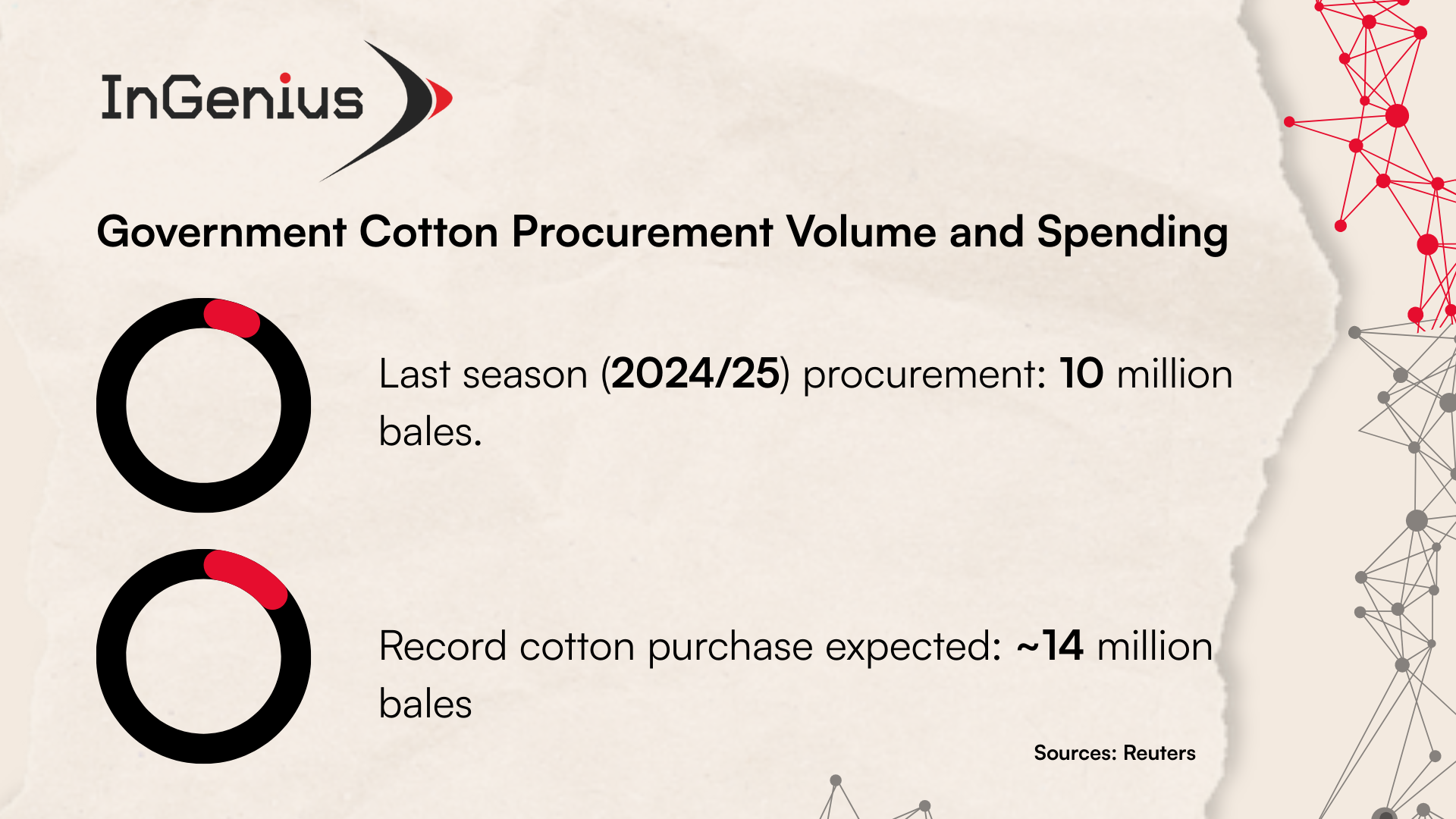
Even though the waiver has ended, imports are still high in late November due to earlier orders placed during that window and continued weakness in domestic prices relative to MSP. As a result, the government is preparing for a large-scale procurement push. According to Reuters, India may purchase up to 14 million bales this season, with the Cotton Corporation of India expanding its network to 550 procurement centres and committing to buy every eligible bale.
Pricing Pressures Amid Rising Import Competition
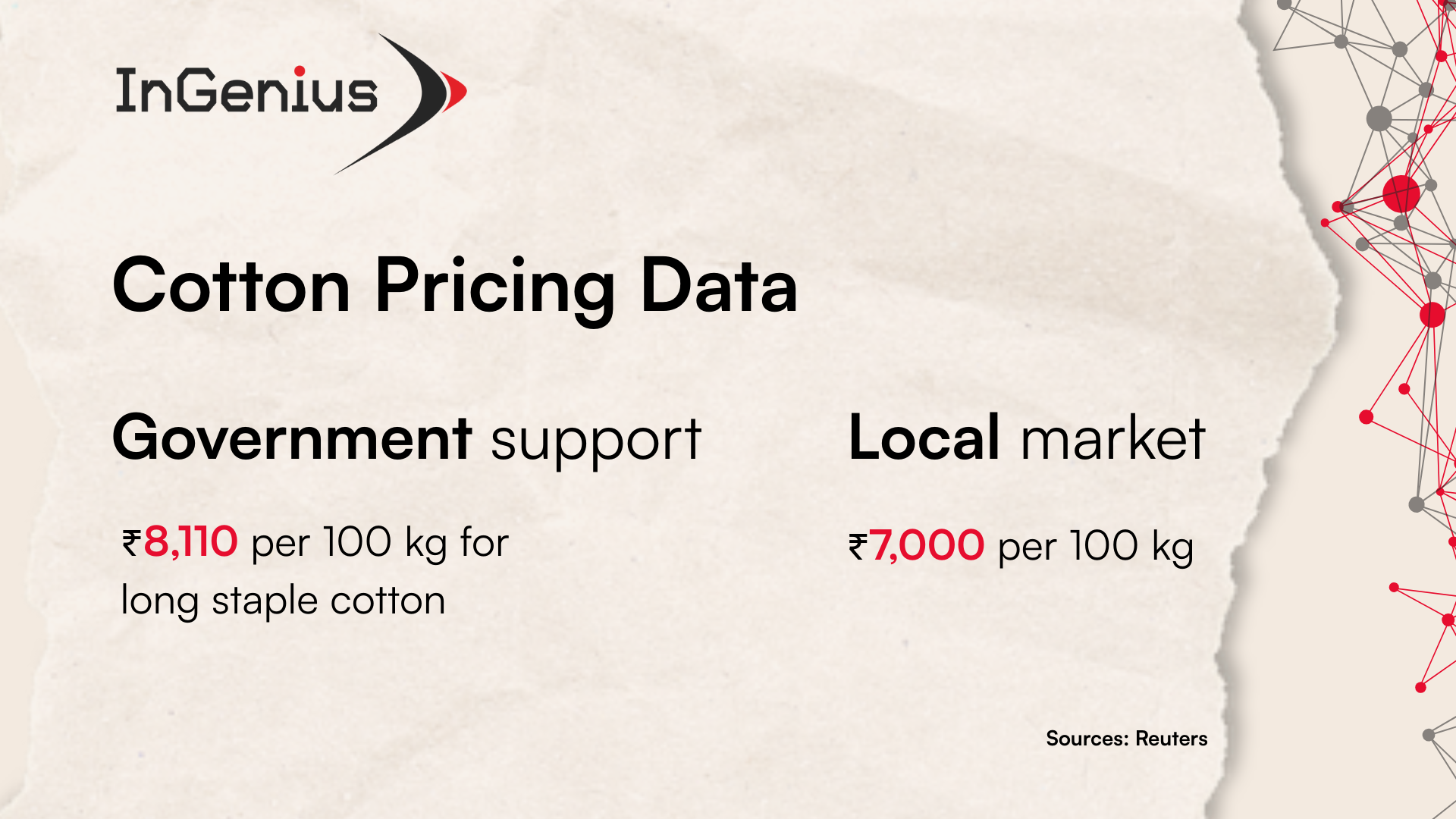
Despite the MSP increase of 7.8%, spot prices in many markets have struggled to stay above support levels. The influx of imported cotton booked during the duty-waiver period continues to weigh on local prices, while weak mill demand, influenced heavily by tariff-hit yarn exports, adds further pressure. High carry-forward stocks from the previous season have also contributed to a market that feels oversupplied.
Market reporting from WHBL/Reuters and insights from the CITI Newsletter highlight that this subdued pricing environment remains one of the biggest challenges for farmers and traders this season.
Digital Innovations Streamlining Procurement
To manage large farmer inflows and improve transparency, the CCI is continuing its digital push through the Kapas Kisan app. The app allows farmers to register using Aadhaar, book time slots for deliveries, and track payment status in real time. According to The Hindu Business Line, this tool significantly reduces wait times at procurement centres and helps prevent crowding during peak arrival days.
US Tariffs Continue to Reshape India’s Cotton and Textile Industry
Indian textile exporters are grappling with effective tariffs of around 50% on shipments to the United States, a combination of the long-standing 25% tariff and an additional 25% tariff implemented in late August 2025. This tariff burden, detailed by Munjal International and the PJTAU September market report, has led to a sharp decline in yarn demand of around 50% in key hubs/segments.
This fall in demand has translated into weaker cotton consumption by mills, reduced export competitiveness, and slower order books, particularly in spinning hubs such as Panipat, Tiruppur, and Bhilwara.
Weather and Crop Outlook Shaping Market Dynamics
The early monsoon concerns have now settled into clearer production expectations. The Cotton Association of India estimates output at 30.5 million bales for 2025–26, while broader industry projections range between 312 and 335 lakh bales.
These estimates are reinforced by industry commentary such as Amit Gupta’s analysis. While the national picture is more stable than earlier forecasts suggested, regional risks, including uneven rainfall and pest incidence continue to shape local yield outcomes.
Strategic Implications for Procurement & Finance Leaders
India’s cotton market in late 2025 is being shaped by several intertwined forces: imported cotton arriving from the duty-free booking period, domestic prices staying below MSP in many markets, high stocks both globally and domestically, persistent US tariff pressure on textile exports, and formalised crop estimates that provide greater clarity on supply.
For procurement and finance leaders, this environment requires close monitoring of price volatility, import competitiveness, export order trends, and MSP procurement timelines. Digital tools like Kapas Kisan, along with AI-based forecasting platforms, are increasingly useful in helping companies navigate cost pressures and plan purchases more strategically.

Final Word: Why It Matters
The cotton sector is navigating an unusually complex year. Global cotton prices remain close to multi-year lows. Yarn demand has weakened under tariff pressure, and earlier import bookings continue to shape the supply. Government procurement is operating at an unprecedented scale.
Organisations that follow price signals closely, understand import flows, and adapt quickly to policy developments will be better equipped to maintain stability in a volatile market. Decision-makers using forecasting tools such as IG Forecaster will have an edge in anticipating shifts and building resilience into their sourcing strategies.

Our products include IG Forecaster for accurate market predictions and IG Portfolio for smarter investment strategies.